
Jigslip - Easy Jigsaw
GAFV GAMESBoard
4.823.00 Reviews
- Version
- 1.0.12
- Installs
- 100.00K
- Age Rating
- Everyone
Screenshots
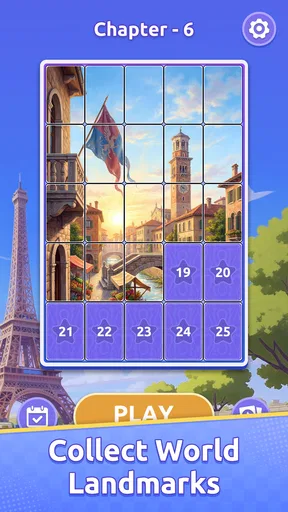
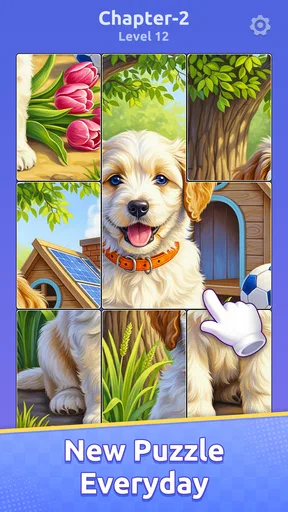
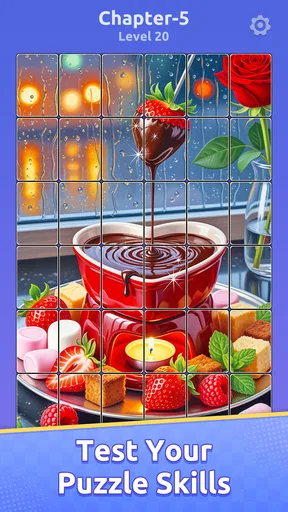
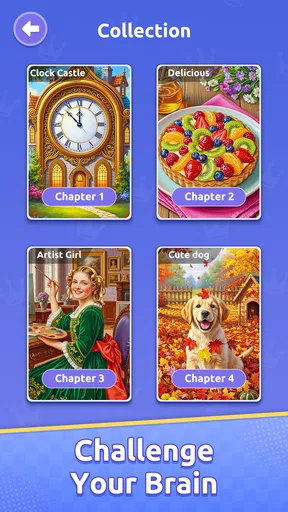

Our Review of Jigslip - Easy Jigsaw
 Analysis by Appyee
I approached Jigslip - Easy Jigsaw expecting a small, uncomplicated board game, and that is exactly where its appeal lies. It turns the familiar act of assembling a picture into a lightweight puzzle experience that is easy to understand from the first touch. I did not need a tutorial-heavy introduction or a long explanation of rules: the basic idea is immediately readable, which makes it suitable for a quick break as well as a longer, quieter session.
The game is made by GAFV GAMES and is free to play, with an Everyone content rating. Its store summary describes it as a jigsolitaire puzzle game, while the short description uses the phrase “Jigslip.” In practice, I found the concept best suited to people who enjoy visual sorting, gentle concentration and the satisfaction of gradually turning scattered pieces into a complete image.
What makes this release worth considering is not a complicated feature list, but the way it places a familiar jigsaw activity into a compact mobile format. It is the kind of game I would keep available for moments when I want something more engaging than scrolling, but less demanding than a strategy game or a timed arcade challenge.
How the current version feels in everyday use
The current version is 1.0.12, and that gives the game a clear early-stage identity. It feels focused rather than overloaded. I can open it with a specific goal in mind—complete one puzzle, clear my head for a few minutes, or settle into a longer session—and the central activity remains easy to return to. That simplicity is a strength because the game does not ask me to learn several systems before I can enjoy the board.
The best way to play is to treat each puzzle as a visual organization task rather than a race. I usually begin by separating pieces with obvious edges or strong colors. From there, I look for shapes that seem to belong together instead of trying to place every piece immediately. This approach is especially helpful on a smaller phone screen, where dragging pieces around randomly can quickly become tiring.
A useful habit is to create a temporary mental map before making many moves. I look for distinctive areas in the image—an unusual color change, a sharp line or a recognizable object—and use those as anchors. Once one small section starts to form, the surrounding pieces become easier to identify. This is a more reliable workflow than repeatedly testing pieces in unrelated places.
The game suits short sessions because a jigsaw puzzle has a natural stopping point. I can make visible progress without committing to a large campaign or a long chain of levels. That makes it a reasonable choice for a commute, a waiting room or a quiet pause between tasks, provided I am comfortable focusing on a visual puzzle rather than playing something with a strong story or competitive goal.
At the same time, the relaxed format will not satisfy everyone. If I want constant surprises, dramatic progression or a clear sense of challenge increasing every few minutes, this is not the right type of game. Its pleasure comes from arranging, recognizing and completing, not from unlocking a complex system.
A practical routine for solving more comfortably
On a phone, I find it better to work in zones. I choose one corner or one recognizable part of the picture and avoid scattering attention across the entire board. When several pieces look similar, I compare their edges and nearby colors before moving them. This reduces the common jigsaw problem of creating a messy pile of almost-correct placements.
Another small but important tip is to pause after completing a cluster. Instead of immediately dragging more pieces, I inspect the new shape as a whole. A finished section often reveals the direction of the next group, especially when the image contains repeated textures. That pause saves time and makes the experience feel more deliberate.
I also recommend playing with a clean screen and a comfortable grip. This sounds obvious, but touch-based puzzle games depend on precise visual feedback. A crowded screen, fingerprints or one-handed use while walking can make a simple placement feel unnecessarily awkward. The game is more enjoyable when I give it a stable few minutes of attention.
What the release information tells me about its direction
The game was released on December 24, 2025, and the current 1.0.12 build places it in a relatively young phase. I read that as a sign to judge the present experience on its own terms rather than assume it already has the depth of a long-established puzzle platform. The version number shows that the product has moved beyond its initial launch build, but it does not by itself promise a particular feature or future roadmap.
For someone installing it now, the practical effect is simple: the main attraction is the current jigsaw activity, not a large history of accumulated modes. I would install it because I like the core idea, not because I expect a mature ecosystem around it. That distinction matters when comparing it with older jigsaw apps that may offer extensive catalogs, advanced customization or years of refinement.
The game has reached over one hundred thousand installs and holds a 4.8 average from around three and a half thousand ratings. Those figures suggest that the straightforward concept has found an audience, but I would still interpret them carefully. Popularity can indicate that the basic experience is approachable; it does not tell me whether the game matches my preferred puzzle difficulty, image style or session length.
There are also twenty-three written reviews associated with the listing, which is a much smaller body of detailed commentary than the rating total. I would therefore place more weight on trying the free game for myself than on assuming that a high average automatically means it will suit every player. A person who loves traditional jigsaws may want more control, while someone seeking a simple mobile diversion may find the restraint ideal.
How existing players may experience the update path
For someone already using an earlier build, moving to version 1.0.12 should be viewed mainly as staying current with the developer’s active release rather than as a guaranteed transformation of the game. I would check the actual feel of the board after updating: whether piece movement remains comfortable, whether the interface is still easy to read and whether my usual solving routine works without adjustment.
The important point is that version information helps establish the game’s present state, but it does not replace hands-on judgment. If I already enjoy the central puzzle, a current build is the sensible one to use. If I was hoping for a completely different kind of game, a version update alone would not change that fundamental expectation.
New players benefit from this same perspective. I would not approach the game expecting a deep progression system simply because it has a newer build number. I would approach it as a focused board puzzle and then decide whether the available experience gives me enough variety and challenge for regular play.
Where the game compares well with familiar alternatives
Compared with a traditional physical jigsaw, this mobile version is easier to carry and quicker to start. There is no table covered with loose cardboard pieces, and I can stop without packing anything away. That makes it particularly useful for small living spaces or for anyone who enjoys the act of assembling an image but does not want the storage commitment of a physical puzzle.
Compared with competitive board games, it is much calmer. There is no opponent pressuring me to make a move, so I can concentrate at my own speed. This is a genuine advantage when I want a low-pressure activity. It is also the main reason someone who enjoys social play may find it too quiet.
Against more elaborate digital jigsaw alternatives, the trade-off is focus. A broader app may be a better choice if I want extensive image collections, multiple difficulty controls, social features or a strong reward structure. Jigslip is more appealing when I prefer the central act of fitting pieces without a lot of surrounding management.
It also differs from word, number and match-three puzzles. Those games often depend on quick recognition, repeated scoring or solving under a defined move limit. Here, the mental work is more spatial and visual. I am not searching for a word or calculating a chain; I am building a coherent picture from partial clues. That makes it a better fit for visual thinkers and a weaker fit for players who need constant action.
Who will get the most from it
I would recommend it to casual puzzle players, fans of jigsaws and people who want a peaceful board game that can be played in small portions. It is also a reasonable option for someone introducing a child or older relative to mobile puzzles, since the Everyone rating and straightforward premise make the concept approachable. As with any touch puzzle, comfort with the device still matters, but the game does not rely on complicated rules to create interest.
A realistic everyday use case is an evening when I have ten or fifteen minutes before bed and do not want the stimulation of a competitive game. I can open a puzzle, sort a few pieces and stop at a natural point. Another is a waiting period where reading feels difficult but I still want to keep my mind occupied. The visual focus gives that time more shape than passive browsing.
I would skip it if my priority is multiplayer interaction, a narrative campaign, fast reactions or a clearly structured achievement chase. I would also look elsewhere if I want a digital jigsaw with extensive personalization and a large collection-management layer. The free price makes trying it easy, but free access does not automatically make a focused game suitable for every taste.
Remaining friction and sensible expectations
The main limitation is the same quality that makes the game approachable: its narrow focus. A simple jigsaw concept can be relaxing, but it can also feel repetitive if I play for long stretches without enough visual variation. I would use it as one part of my puzzle rotation rather than assume it should replace every other board game on my phone.
Touch controls can create another point of friction. On a small display, similar pieces may be difficult to distinguish, and repeatedly dragging them can become less comfortable than handling physical pieces. I find that slower, more intentional movements help, but players who prefer precise mouse-style control may need time to adjust to mobile interaction.
There is also a difference between a high rating and a perfect personal match. The 4.8 average is encouraging, yet my own decision would depend on whether the available puzzles provide enough challenge and whether the visual presentation keeps me interested. I would give the game a short trial session before deciding whether it deserves a permanent place on my device.
Because the game is free, it is easy to test without making a purchase decision first. That is useful for families and casual players, but I would still pay attention to how the experience fits my habits. A free game that I rarely open is less valuable to me than a modest, focused game I return to several times a week.
What I would watch as the product develops
With GAFV GAMES still presenting a young release, I would watch for changes that improve the solving experience without burying its simplicity. The most meaningful developments would be those that make piece handling clearer, keep boards comfortable on different phone sizes and add variety in ways that support the puzzle rather than distract from it.
I would also be interested in how the game balances accessibility with challenge. Beginners need a welcoming starting point, while experienced jigsaw players need enough complexity to avoid finishing everything too quickly. The strongest direction would preserve the easy entry while giving regular users reasons to return.
For existing players, the best sign of healthy evolution would be practical refinement: smoother interaction, clearer visual feedback and a growing sense that the game respects the player’s time. For new players, the question is simpler: does the current build already provide the kind of calm, visual problem-solving they want? If the answer is yes, there is little reason to wait for a future promise.
My final recommendation
Jigslip - Easy Jigsaw works because it does not make the basic pleasure of a jigsaw puzzle harder than it needs to be. I like it as a quiet, focused board game for short sessions, especially when I want to sort shapes and colors without competing against a clock or another player.
Its free availability, Everyone rating and accessible concept make it easy to try, while the current 1.0.12 release shows a product that is still developing rather than a fully established puzzle collection. I would recommend it to casual players who value simplicity and portability. I would point dedicated jigsaw enthusiasts toward a broader alternative if they need extensive controls or a larger long-term catalog.
My honest view is that this is best treated as a compact puzzle companion, not an all-purpose game platform. If that role sounds useful, it is worth installing and testing with a patient solving routine. The right reason to choose it is the calm act of completing a picture, not the expectation of a complicated game system.
Verdict
Strengths of Jigslip - Easy Jigsaw
- Simple interface makes puzzles easy to start and navigate.
- Multiple difficulty levels suit both casual and experienced players.
- Relaxing gameplay works well for short breaks or longer sessions.
- Completed puzzles provide a satisfying sense of progress.
- Touch controls make arranging and rotating pieces feel intuitive.
Limitations of Jigslip - Easy Jigsaw
- Some puzzles or features may require in-app purchases.
- Ads can interrupt the experience, especially between puzzle sessions.
- Small pieces may be difficult to handle on compact phone screens.
- Limited challenge variety may reduce replay value for advanced players.
- Offline availability may vary depending on the selected puzzle content.
Similar Picks in This Category
View All
Ludo King®
Gametion4.1

Ludo
Yarsa Games4.6

Tile Master® - Matching Game
Higgs Studio3.6

Checkers Online
CC Games4.6

Dominoes
Loop Games4.7

Chess
Chess Prince4.6
Frequently Asked Questions
What is Jigslip - Easy Jigsaw?
Jigslip - Easy Jigsaw is a casual puzzle game focused on completing digital jigsaw puzzles in a simple, relaxing format. Players arrange scattered pieces to recreate images, making it suitable for short sessions or longer play. Its easy-to-understand gameplay is designed for beginners, while different puzzle images and difficulty options can provide a more engaging challenge for experienced players.
Is Jigslip - Easy Jigsaw suitable for beginners and children?
Yes, Jigslip - Easy Jigsaw is generally approachable for beginners because its main mechanic is straightforward: select, move, and correctly place puzzle pieces. The relaxed nature of the game makes it easy to learn without complicated controls. However, parents should still review the app’s age rating, advertising content, and privacy information before allowing younger children to use it.
Does Jigslip - Easy Jigsaw work without an internet connection?
Offline availability may depend on the specific version of Jigslip - Easy Jigsaw and the features you want to use. Basic puzzles may be playable without a constant connection once the necessary content has loaded, while advertisements, online image libraries, updates, or other services may require internet access. It is best to test the game in airplane mode after installation.
Are there advertisements or in-app purchases in Jigslip - Easy Jigsaw?
Jigslip - Easy Jigsaw may include advertising or optional purchases, depending on the platform, region, and version installed. Ads can sometimes appear between puzzles or while accessing certain features, while purchases may offer additional content or remove advertising. Before downloading, check the Google Play or App Store listing for current pricing, subscriptions, and purchase details.
What devices are compatible with Jigslip - Easy Jigsaw?
Compatibility depends on whether you download Jigslip - Easy Jigsaw for Android or iOS and on the operating system requirements set by the developer. Most relatively modern phones and tablets should handle a lightweight jigsaw game, but older devices may experience slower performance or limited support. Always check the official store page for the latest version requirements before installing.
Play our best games!


